Fire Buffs promote the general welfare of the fire and rescue service and protect its heritage and history. Famous Fire Buffs through the years include New York Fire Surgeon Harry Archer, Boston Pops Conductor Arthur Fiedler, New York Mayor Fiorello LaGuardia and - legend has it - President George Washington.

Thursday, June 27, 2013

SKYLINE - 1973


The rumble could be heard for miles.

On March 2, 1973, the center section of the 24-story Skyline Center in Bailey’s Crossroads, which borders Arlington, gave way.


The cascading concrete and steel killed 14 people and injured 34 others.

A Fairfax County police officer, Kirk Osgood, witnessed the collapse and radioed for help at 2:18 p.m., according to Fairfax County Fire and Rescue Department archives.

Engine 6, Truck 6 and Rescue 6 responded from Falls Church along with Fairfax County units, according to John Franklin, a retired Arlington firefighter who was assigned to Rescue 6 that day.

"Back in 1973, Station 6 was also dispatched by Fairfax and was on the scene before Arlington was asked to send units," said Franklin, who retired in 2000 after 30 years on the job. 


Arlington County answered Fairfax County’s request for mutual aid with four ambulances – Rescues 1, 4, 5 and 10 – and Engine 9.
 
Truck 3 and the foam wagon were also dispatched, with the foam wagon carrying the Arlington County recruit class.
 
A canteen wagon operated by the ladies auxiliary of the Arlington firefighters’ union also provided assistance.

For Fairfax County, the recovery effort would continue for two weeks, when the last body was recovered.


Following is a wire service report on the incident:
 
 
Bailey's Crossroads, Va. (UPI) -- A huge unmanned crane plunged through 23 stories of a building under construction in a suburb of Washington Friday, slicing the structure in two as it crashed through floor after floor into the basement. At least six persons were killed and 34 injured.


An undetermined number of workmen were missing and feared buried under tons of concrete rubble.

Several survivors were plucked off the remains of the roof by a helicopter. Another was located buried under the rubble but still alive, and fed oxygen through a tube by a disaster team from a nearby hospital.

A scratching sound also was heard late Friday under an adjacent garage that fell in when the main building collapsed.

The crane toppled over on the top of the building and with a thundering roar "like an earthquake," plummeted through floor after floor as workmen below ran for their lives.

The building, sliced into two separate structures, remained hazardously up-right, held by two remaining end walls and remnants of the 23 floors. Officials said it appeared to be standing stably enough to conduct search operations.

Rescuers assembled a 100-foot boom crane late Friday night to clear away the debris.

Firemen from 14 suburban companies stood by protecting against the possibility of a flash fire or explosion from leaking propane gas tanks buried under the tons of concrete.

"This is going to take all night or even all day tomorrow," said a Fairfax County official. "It may be two or three days before we know for sure how many fatalities there were."

"Some of the men who are now missing might be home having a beer, some who we thought were missing have called in from home," he said.

 
Several survivors were plucked from the top by an Army helicopter after tossing crumbled notes to the ground pleading, "Please for God's sake, get us off this building."

THEATER FIRE - 1811


In the Virginia state capital of Richmond on Dec. 26, 1811, fire destroyed the Richmond Theatre, killing 72 people including Governor George William Smith.

U.S. President James Madison and future president James Monroe were in the audience, according to Wikipedia.

Firefighters were unable to stop the inferno and the building collapsed.

The theater was located on the north side of Broad Street between what is now Twelfth and College streets. 

MCCRORY'S - 1929

UPDATED AUGUST 2019

Photo: Harris Ewing Collection glass negative

Photo: Ghosts of D.C.


In the 1800s and into the early 1900s, boiler explosions were a common occurrence.

Across the U.S., there were 499 boiler explosions reported in 1911, accounting for 222 deaths and 416 injuries, according to statistics from the Hartford Steam Boiler Inspection & Insurance Co. as reported by the Journal of The Cleveland Engineering Society, May 1913.

In Washington, D.C.
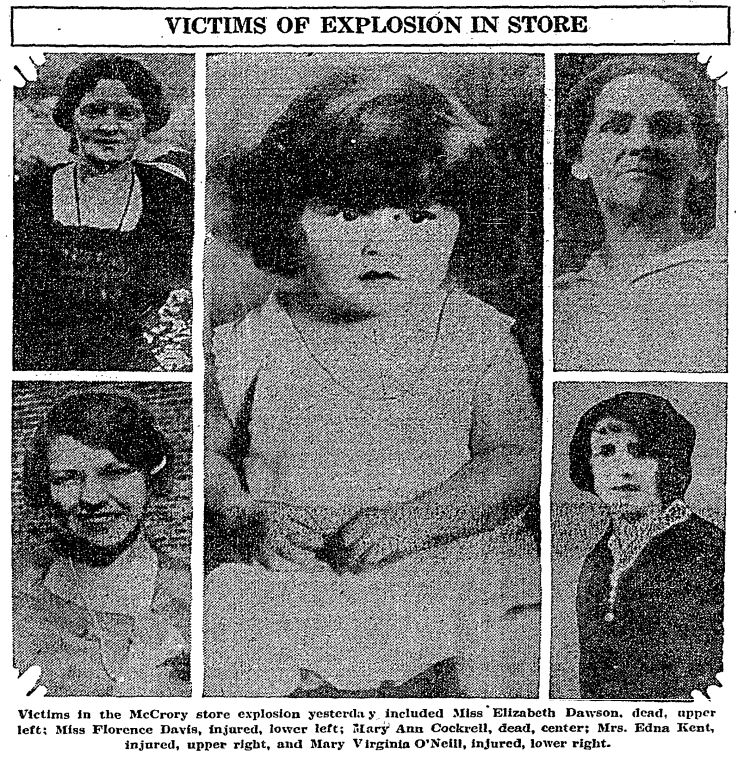
, a boiler exploded at the McCrory's store at 416 Seventh Street, Northwest, killing six people and injuring many others on Nov. 21, 1929.

Passersby were among the victims.

"The explosion lifted part of the concrete sidewalk about 40 feet square in the air," according to an Associated Press dispatch in the Ellensburg Daily Record in Washington state.

"Firemen arriving immediately began digging beneath the ruins for bodies," the AP reported.


"Steam poured upon the cavity upon a score of firemen as they worked feverishly to lift the huge blocks of concrete which had fallen," AP said.

Seventh Street was the city's retailing district.

The incident went to four alarms.

Police detective Benjamin Keuhling, who was in the neighborhood when the boiler exploded, told the United Press:

"
I saw a man hurled 30 feet, and a woman shoot straight up in the air. It was a miracle that at least 20 persons were not killed."

Among the dead:
  • Elizabeth Dawson
  • Charles Jacobson  
  • Anna Mae Cockerell
  • Cockerell's her daughter Mary Ann, age 2 
  • Catherine Cullinaine, aunt of Cockerell

Wednesday, June 19, 2013

BALLSTON - 1999


Photo: Falls Church Volunteer Fire Dept.
House fire at North 13th and Stafford streets in the Ballston area of Arlington, Virginia, in January 1999. The plume of smoke was visible for miles. Firefighters were briefly trapped in the basement of the burning dwelling. A quint (probably Quint 104) has its aerial extended. 

Sunday, March 31, 2013

FOAM 161 REBORN


American history on wheels.

On Sept. 28, 2012. the Fort Myer Fire Department's former foam unit arrived at the Patton Museum maintenance shop at Fort Knox, Kentucky, for refurbishment.

The vehicle - designated Foam 161 - was stationed at the Pentagon firehouse on Sept. 11, 2001 and sustained heavy damage in the crash of American Airlines Flight 77.

Its crew of three firefighters escaped serious injury.

CLICK HERE FOR MUSEUM'S FACEBOOK PAGE

ENGINE 102


Engine 102
 
Arlington County Fire Department 

Manufacturer: Pierce
Delivery Date: April 18, 2012
Job Number: 25189-01-02
Pump: Hale Midship
Pump GPM: 1500
Tank: Foam, Water
Tank Size: 40/750
Safety: Hands-Free SCBA Brackets
Category: Pumpers
Model Type: Pumpers
Chassis: Arrow XT ™
Body: Pumper
Overall Height: 9'8"
Engine: Cummins ISM
Horse Power: 450
Foam System:  Akron 125 GPM 


TRUCK 105


Truck 105

Arlington County Fire Dept.
 
Manufacturer: Pierce
Delivery Date: May 8, 2012
Job Number: 25190-01-02
Pump: Hale Midship
Pump GPM: 1000
Tank: Water
Tank Size: 300
Generator: Onan Hydraulic
Safety: Hands-Free SCBA Brackets, Side Roll Protection system, VLH® Caps
Category: Aerials
Model Type: 100' Heavy Duty Ladder
Chassis: Arrow XT ™
Body: 100' Heavy Duty Ladder
Overall Height: 11'8"
Engine: Cummins ISM
Horse Power: 500

Tuesday, October 23, 2012

WHITE HOUSE

Christmas Eve at White House

Christmas Day

Box 157 - Executive Mansion
1600 Pennsylvania Ave., NW
1st Alarm assignment: 1-2-16-23-RS1
2nd Alarm: 6-4-13-9
3rd Alarm: 3-7-12-21
4th Alarm: 5-11-8
5th Alarm: 10-24-28-26

1929 was a lousy year for President Herbert Hoover.


The stock market crashed in October, ushering in the Great Depression - and fire gutted his White House office on Christmas Eve.

Following is an account of that long-forgotten fire.

It was penned by the late Robert Debs Heinl Jr., a Marine Corps colonel and fire buff, who witnessed the blaze as a 13-year-old boy.

_______________________________


Box 157—the White House! ... in all Washington fire stations, polished brass gongs chimed: 1-5-7
By Col. ROBERT DEBS HEINL, JR., USMC 

On Christmas morning of 1929 Fire Marshal C. G. Achstetter of Washington, D.C., commenced the tedious paperwork that follows a $135,000 fire. Reaching for his office form, “Fire Marshal’s Record of Fire,” he noted that it had been a hard month: 779 fires to date in 1929, and this most recent one was number 162 in December alone.

Address—“1600 Pennsylvania Avenue, N.W.,” he recorded. Structure—“detached brick, covered with stucco.” Occupant—“Herbert C. Hoover.” Then, “First alarm Box 157, 8:09 P.M., 24 December; outstroke, 7:27 A.M., 25 December.”

Only a few hours before Achstetter started work on his report, 1600 Pennsylvania Avenue, N.W. —the White House—had been bright with Christmas gaiety.

On their first Christmas Eve in the Executive Mansion, President and Mrs. Hoover were holding a young people’s party. The children of the President’s staff were rollicking through the hallways. Parents—watchful, prideful, a little indulgent but not too much—hovered on the fringes and kept one eye on the kids and one on the President. A few older boys in their first dinner jackets gathered in an aloof knot about young Allen Hoover, down from Harvard, and Walter Newton, just eighteen, resplendent in an Annapolis plebe’s full dress. Even more glorious, a scarlet-coated section of the Marine Band played Christmas songs in the East Room and then in the State Dining Room. In the latter, refreshments were served, games played, and presents distributed.

Outside there was real Christmas weather. Snow was on the ground, and ice frosted the windowpanes. In the West Wing of the White House the Executive Offices were quiet. The simple security force of 1929, a Secret Service man and a policeman, patrolled the offices, and one operator, M. M. Rice, tended the White House switchboard. Rice, the newest and youngest man on the roster, had caught the Christmas Eve shift.

Built in 1903 by Theodore Roosevelt at a cost of $65,000, the Executive Offices formed the extreme west portion of the White House. In 1929 this wing housed (as it does today) the President’s office, an oval greenwalled room on the central south face. Elsewhere on the main floor were the offices of Mr. Hoover’s three secretaries, predecessors of today’s multitudinous White House staff; the half-club, half-office press room; and clerical spaces overflowing into the semibasement, where Rice manned the switchboard. Above the high-ceilinged main floor was an attic crammed with dead files and, it seemed, at least one copy of every government pamphlet issued since the days of T. R.


President Hoover

Who first spotted the fire will never be known. Rice, whose post was directly under the office of Hoover’s secretary Walter H. Newton, Midshipman Newton’s father, saw wisps of smoke shortly after 8 P.M. and immediately phoned the Secret Service and White House Police offices. Then he notified the White House major-domo, Chief Usher Irwin “Ike” Hoover, no relation to the President.

While Rice was juggling plugs and cords on the manual switchboard, an office messenger, Charlie Williamson, smelled the smoke fumes on the main floor. Running for help, he encountered Secret Service agent Russell Wood and policeman Richard Trice. Tracing the thickening smoke, Wood and Trice mounted a stairway to the attic. Wood opened the door and was hit by a wall of heat.

“The whole loft is burning up!” Wood shouted. He raced downstairs for a fire extinguisher while Patrolman Trice ran to turn in the alarm. As Trice descended, he pulled the main lighting switch. Nothing happened. Fire was inside the partitions, and the wires were burned away.

In the main wing of the White House, Ike Hoover was overseeing the Christmas party. When Rice’s call came through from the switchboard, the chief usher—casehardened against crisis by thirty-eight years under nine Presidents—tiptoed into the State Dining Room and whispered to Lawrence “Larry” Richey, the President’s personal secretary, and to the President.

“The Executive Offices are on fire,” he told Mr. Hoover. “I want to take the secretaries away from the table.”

“I’ll go, too,” replied the President. In stiff-upper-lip manner, he directed the Marine Band to strike up a lively tune and then made for the West Wing. His aides quickly excused themselves, and, joined by Allen Hoover and Midshipman Newton, they followed the President. “Mrs. Hoover,” reported the Washington Star, “remained behind and directed the fun.”

The first persons into the President’s office were Larry Richey and the Hoover and Newton boys (who, the Star approvingly said, “played a man’s part”). In the already smoke-filled office the three cleared off the desk and began manhandling files out of the room. President Hoover, who had pulled a heavy blue topcoat over his dinner jacket, arrived moments later and took charge. But Secret Service men, tumbling in from all parts of the White House, hustled the President and everybody else out of the office. Mr. Hoover thereupon took post on the roof of the adjacent conservatory, donned a black hat brought by his valet, and lighted a cigar.

Meanwhile, Patrolman Trice had finished his sprint to the White House fire alarm box (Number 157, a typical red Gamewell model of the era). He broke the glass, turned the handle, opened the door, and pulled the hook.

At Fire Alarm Headquarters there came a single tap on the “joker” as the box was pulled. There was a pause, then the box number rang in. After another pause, a second round of bell strokes commenced.

Box 157—the White House !” sang out the telegrapher. The switchboard man swiftly cranked in the uptown home of Chief Engineer George S. Watson. Seconds later, in all Washington fire stations, polished brass gongs chimed: 1-5-7 …1-5-7 …1-5-7. …


The brass gongs chime 1-5-7

As the big new 1927 Seagrave pumper of Engine 1, the first-due engine at the White House, roared through the front gates, Captain Edward O’Connor could already see fire behind the small attic windows of the West Wing. So could Central Battalion Chief C. W. Gill as he sped westward along Pennsylvania Avenue. With Engine i’s line stretched from the pumper to the front door of the Executive Offices, Chief Gill led the hosemen inside the smoke-charged building. Amid the heat and fumes, Gill called for Rescue Squad 1, in those days the only firemen with “smoke helmets” (respirator masks), to lead the way up the attic stairs. As they advanced the hose line into the attic, the atmosphere grew thick and heavy. Suddenly a rush of hot gas, a blast of heat, and a fireball of flame whooshed into the stair well, blowing Chief Gill and most of his crew down to the main floor.

Because of back draft, the fireman’s most dangerous foe, superheated fumes were ignited when fresh air from the stairway reached the fire in the attic. As Gill staggered to his feet amid the injured—four men were down—his first action was to order a second alarm. Then he reorganized his people, called for water, and advanced upward again behind Engine 1’s stream.

While the first-due companies in front of the White House had their hands full with what was evidently a “working fire,” Engines 16 and 23, responding at the rear, had problems of a different kind. Although they could see the fire plainly enough, the massive iron gates on the sides and rear of the White House grounds were locked and barred.

This contingency was one that Chief Engineer Watson had long ago foreseen. As a result of his urgings, master keys to the White House gates had been issued to the captain of each company due on a first alarm from Box 157. What Chief Watson could not have foreseen, however, was what now happened. With Keystone Cop supersecurity the Secret Service had had the locks changed but failed to notify the Fire Department. Thus when Engines 16 and 23 reached the east and west rear gates, they, together with Truck 3, whose 85-foot aerial ladder could reach the burning roof, had to wait in the street until puffing White House policemen could get the keys and run to open them.

When the back draft blew Chief Gill down the attic stairs, the time was approximately 8:15.∗ A minute later Deputy Chief Engineer P. W. Nicholson rolled in at the rear, took one look at Truck 3’s ladder being cranked up and at the fire in the windows, and at 8:17 ordered a third alarm. With Chief Gill’s second alarm at 8:16, this meant that eight additional engine companies, two more truck (that is, hook-and-ladder) companies, and the water tower were converging on the White House from all over central Washington as fast as the snorting new motorized pieces could travel.

∗This was six minutes after the time recorded for the first alarm! The records are perhaps not entirely precise.—Ed.

Like Sheridan at Cedar Creek, Chief Watson was also approaching the scene at high speed, but in his red Cadillac touring car, not on horseback. “I was notified by Fire Alarm Headquarters,” he reported, “that the White House box was being received and immediately left my home and proceeded to the White House as rapidly as traffic congestion would permit.” This is something of an understatement. With isinglass side curtains whistling, Watson’s rig covered the thirty-five-block stretch from his house to the President’s through downtown evening traffic in eight minutes flat.

Reaching the site of the fire at 8:18, Chief Watson gave orders for deployment of the incoming second- and third-alarm companies; then, seeing flames already breaking through the roof and skylights, he ordered a fourth alarm. This would bring four more engine companies, call in off-shift men to activate reserve pieces, and fully mobilize Washington’s then and to this day highly efficient Fire Department. With the fifth and final alarm, sounded at the fire’s height at 9:24 P.M., roughly two thirds of the department was concentrated in the Lafayette Square area, some pumpers taking water from hydrants from as far as five blocks away.

What faced Chief Watson was a government office fire of a stubborn type only too familiar to D.C. firemen: a cramped space overflowing with paper, with virtually no accesses or vents, heavily charged with fire and heat. It has happened many times before and since 1929 in offices of the Commerce, Agriculture, and Treasury departments, as well as in that great pyramid of paperwork, the Pentagon. It was also the sixth fire in the history of 1600 Pennsylvania Avenue. The first, in 1814 (arson committed by British soldiers), was followed in 1866 by a serious fire in the conservatory (President Hoover’s vantage point in 1929), then by two small blazes in Woodrow Wilson’s time, and by one kitchen fire during the days of Calvin Coolidge.

The firemen’s first tactics were to get onto the roof of the West Wing and play streams of water into the White House skylights. They soon discovered, however, that most of the skylights gave onto partitioned air shafts going directly down to the main floor. Not much water could reach the seat of the fire this way, but it did get elsewhere. White House reporters, braving the smoke to salvage files in the press room (not to mention the new Webster’s dictionary and stand they had recently chipped in for), enountered water over their high-topped shoes throughout the main floor. In the basement, working by kerosene lantern, Rice stayed by his switchboard until, with icy water knee deep, his boss ordered him to shut down. Six men from Engine 16 and Truck 3, working to save the President’s office proper, were flattened when the ceiling, weakened by water and fire, crashed down. Miraculously, four were unhurt, but the crystal chandelier took its toll on two. Outside, the streets and walls and firemen were sheeted with ice.

“Great calcium lights set up in Executive Avenue,” reported the Chicago Tribune, “added their glare to the blazing structure to make the White House grounds as light as day.”

The scene revealed by the great calcium lights was, by 9 P.M., one of considerable interest and variety. Word that the White House was afire had drawn a widely mixed audience.

From his perch on the conservatory roof, Mr. Hoover continued to watch the fire, “puffing nervously,” as the Star noted, “on a cigar.” On his own initiative, Secretary of War Pat Hurley had ordered out 150 soldiers from Washington Barracks (now Fort McNair), who, in one newspaper-account, “formed a human wall” to hold back the crowds. Across the Potomac at Fort Myer a troop of the 3rd Cavalry were standing to horse in case their services might be needed. (Until the 1930’s both the Treasury Building and the adjacent White House had a direct bell system for calling Fort Myer’s cavalry to the rescue in times of emergency.)


Secretary of War Pat Hurley

One hundred men of the Metropolitan Police supplemented the Army’s “human wall.” Screeching to the scene in their open-topped, brass-railed special paddy wagons, the police reserves had mainly come in on the second and third alarms, but the five-man crew from No. 3—known on the force as “the White House precinct”—responded on the first alarm and did yeoman’s service in salvage. Even with all reserves deployed and the presence of the soldiers, a swarm of Secret Service men, and White House police, the Metropolitan Police’s Major and Superintendent Henry G. Pratt reported that “men who attempted to masquerade as high government officials in order to get a closer view of the fire were quite troublesome.”

Directly interested in a closer view of the fire (since he was ultimately in charge of the White House and its premises) was the grandson of a former occupant, Lieutenant Colonel U. S. Grant III, of the Army Engineers. As officer in charge of B.C. public buildings and public works, Grant left his Christmas Eve table and spent most of the night at the fire, mainly making arrangements to find President Hoover a new office. Finally, by dislodging such high-ranking tenants as the Army’s Judge Advocate General, Inspector General, and Chief of Chaplains, Grant got the Presidential staff into the venerable State, War, and Navy Building across West Executive Avenue from the burning wing. Hoover himself took over the office of the former Chief of Staff, General of the Armies John J. Pershing.

Not an immediate problem for Colonel Grant, but of interest to taxpayers, was the fact that, like all federal buildings, the White House was (and is) uninsured because the total annual premiums would cost too much. Fortunately, irreplaceable mementos and the President’s personal flag had been saved. The rescue of the flag was effected by Honorary Deputy Chief Henry C. Stein, one of Washington’s leading fire buffs. Fully suited for the occasion in boots, waterproof coat, and white helmet, Stein plunged into the President’s office and emerged with the flag while the crowd cheered. An official of the American Legion, Elmer John Giggin, who witnessed the deed, wrote, “I have seen service, but never saw a finer lesson than was taught me Christmas Eve night.”

Meanwhile the Christmas party ran its full course. (“PARTYCONTINUES DESPITE FLAMES,” headlined the Star.) Many guests, in fact, did not learn until afterward what had happened. Mrs. Hoover finally got the President to bed about midnight.

At 7:27 A.M., Christmas morning, the White House fire was officially declared out, although Engine 1, first in, stayed all day to prevent rekindles. The cause of the fire was found to be an overheated flue in the open fireplace that had glowed cheerily in Secretary Newton’s office in the northwest corner of the wing. Fifteen firemen had been injured, but the White House was saved.


Oval Office after fire
Once installed in his new offices, the President immediately sent what for him was a warm letter:

My dear Chief Watson :

I want you to know of my appreciation of the excellent service rendered by you and the men of your Department during and following the fire in the Executive Office on Christmas Eve. It was a fine piece of work and I thank you sincerely for all your efforts.

Yours faithfully,
Herbert Hoover

The fire had one other sequel. The Secret Service promptly gave Chief Watson a set of White House keys that worked.

President Hoover in refurbished Oval Office, 1930

Wednesday, October 10, 2012

AIRPORT RIG


Metropolitan Washington Airports Authority
Oshkosh Striker 3000

Tuesday, September 11, 2012

9/11


Firefighters at Pentagon in September 2001 
    
“As painful as this day is and always will be, it leaves us with a lesson that no single event can ever destroy who we are, no act of terrorism can ever change what we stand for” - President Obama on 11th anniversary of Sept. 11 attacks

CLICK HERE for Arlington Fire Journal Account of 9/11/01


Photo: Stars and Stripes

Monday, September 10, 2012

HAPPY DAYS


Photo: ACFD Virtual Museum
It's September 1958. President Eisenhower is in the White House and this 1955 Ward LaFrance is ready to roll at Fire Station No. 5, Jefferson District.

Friday, August 10, 2012

AT THE PLUG


Wagon 3 "at the plug" in the late 1960s or early 1970s. Photo from the collection of the late Frank Higgins, Arlington County Fire Department. Frank was a gifted fire photographer.  

Sunday, August 05, 2012

OPENING UP


Scene from August 1979 - Crews open up roof in this photo of a house fire from the files of the Falls Church Volunteer Fire Department. Arlington County Firefighter Mike Kilby is on the ladder according to a note accompanying the photo.

Friday, February 10, 2012

MEDIC DIES - 2012


Paramedic Joshua Weissman, 33, of the Alexandria Fire Department, died Feb. 9, 2012, from injuries sustained in the line of duty.

Crews from the City of Alexandria and Arlington County responded to a car fire on I-395 near Glebe Road on Feb. 8. Weissman fell from the highway into Four Mile Creek and sustained a severe head injury.

He was taken to the Washington Hospital Center trauma unit.

Monday, February 06, 2012

OBAMA VISIT

President Obama meets firefighters following his remarks on the Veterans Job Corps at Fire Station No. 5 in Arlington County, Virginia, on Feb. 3, 2012.

Official White House Photo by Pete Souza

Friday, December 02, 2011

RIGHT TO VOTE

"On Nov. 8, 1960, members of Rescue 6 were called upon to transport a resident from Anderson Clinic to Mt. Daniel Elementary School, her local polling place, to vote," according to the Falls Church Volunteer Fire Department website.

WAITING FOR RUN

Arlington County Fire Department Capt. Sam Krigbaum (seated) and Firefighter Jack Higgins waiting for a run in the kitchen of the old Clarendon firehouse. This December 1955 photo is from the collection of Capt. Randy Higgins.

Thursday, December 01, 2011

FIRE STATIONS - 2011

New No. 3 - Cherrydale Fire Station - Opened 2011


APPARATUS ROSTER

No. 1 - Glebe Road - E101, M101, B111, Hazmat
No. 2 - Ballston - E102, M102, EMS102, Command Unit
No. 3 - Cherrydale - E103, B112, Bomb Squad
No. 4 - Clarendon - R104, T104, M104
No. 5 - Crystal City - E105, T105
No. 6 - Falls Church - E106, T106, M106, Volunteer Units
No. 7 - Fairlington - E107
No. 8 - Halls Hill - E108
No. 9 - Walter Reed - E109, R109, M109
No.10 - Rosslyn - E110, M110, Technical Rescue
No. 61 - Fort Myer (U.S. Army) - E161
No. 301 - National Aiport (Airport Authority) - ARFF

E = Engine
T = Truck
M = Medic
EMS = EMS Supervisor
B = Battalion Chief

Friday, October 21, 2011

ROSSLYN - 1945


The Virginia shoreline burst into flame on Dec. 9, 1945.

"The early-Sunday quiet of Rosslyn, Va., was spectacularly broken when a 5000-gallon runaway truck-trailer loaded with high test gasoline crashed into a parked milk truck and exploded," The Washington Post reported the next day.

Eight Arlington County volunteer companies answered the alarm and the District of Columbia Fire Department sent 16 pieces of equipment.

"Blazing gasoline roared through a storm sewer into the Potomac, setting the surface of the river ablaze," the Post said. "The district fire boat was rushed to the scene to prevent the flames from reaching oil barges tied up near Key Bridge."

The Arlington Trust Co. building was gutted, storefronts within 200 feet were scorched and a black cloud hung over Rosslyn and Georgetown.

And yet no one was hurt in the inferno.

Lee McCanless, 26, of Baltimore, driver of the E. Brook Maitland Oil Co. tractor-trailer, said his brakes failed on the Key Bridge.

"Right after the crash the flames started blazing up all over the trailer," said McCanless, quoted by The Washington Post. "They shot up twice the height of the bank."

His face and clothes blackened, McCanless jumped free and ran across Rosslyn Circle to safety.

Andrew Kovat, 37, of Hyattsville, driver of the Thompson Dairy truck, was across the street at the Rosslyn Lunchenoette, eating breakfast.

The newspaper called Kovat's breakfast "a meal which probably saved his life."