Fire Buffs promote the general welfare of the fire and rescue service and protect its heritage and history. Famous Fire Buffs through the years include New York Fire Surgeon Harry Archer, Boston Pops Conductor Arthur Fiedler, New York Mayor Fiorello LaGuardia and - legend has it - President George Washington.

Thursday, February 14, 2008

CIVIL WAR WEAPON FOUND

Old Arlington Hall

By David Shultz
of
The Connection newspaper

A PIECE of weaponry dating back to the Civil War was discovered underneath a local Arlington building.

The weaponry consisted of an unexploded shell from the mid-1800’s. It was discovered on the evening of Jan. 31 underneath Arlington Hall which is located on Route 50 between Glebe Road and George Mason Drive.

Benjamin Barksdale, the Chief Fire Marshall for Arlington County, said that “They were doing some construction work and one of the construction people found it and called 911… You could clearly see it was a shell. It was one foot long, five inches in diameter. It looked like a large bullet.”

He said that County fire officials were unsure if the shell was live but, as a precautionary measure, the workers who were in the building above the shell were temporarily moved to another part of the building.

Because the shell was found on federal property, Barksdale said that bomb experts from Fort Belvoir were brought in to handle the shell.

The Arlington County Fire Department has handled buried munitions before, Barksdale said, but “Not like that… We’ve come across more modern day stuff. Every once in a while we’ll get a call that someone has got something from [the] Vietnam [era].”

Tuesday, February 12, 2008

KENNEDY GRAVE - 1982


On Nov. 28, 1982, tourists visiting Arlington National Cemetery discovered the charred body of a man at the grave of President John F. Kennedy - lying three feet from the eternal flame, The New York Times said. Police determined the man was intoxicated and had been trying to light a cigarette with a rolled newspaper.

Thursday, February 07, 2008

ALARM SYSTEM

UPDATED MARCH 2008

Old bell at Station No. 4

Heart attacks from stress are a leading cause of firefighter deaths, so the Arlington County Fire Department has found a safer way to ease firefighters into emergencies - a soothing computer-generated voice over firehouse public address speakers.

Rather than the blast of an airhorn, a piercing radio tone or a bell jolting them into action, firefighters are alerted by a calm female voice - "Engine Company, structure fire" for example - followed by full details announced by a live 911 dispatcher.

Battalion Chief Ben Barksdale said the system has improved response times because firefighters aren't startled, according to Channel 5 News.

Regarding the ``soothing alarm,'' a Fire Journal reader - who grew up in Ohio many years ago - writes:

``Even as a kid, my heart always took a jump when Columbus rang four quick blows on a bell - sharp and loud - over the radio as a prefix to a structural response.They changed it some years later to a tone, that was only slightly less terrifying.''

Monday, March 10, 2008

By Daniela Deane
Washington Post Staff Writer

Jesus Escobedo is nodding off atop his Batman sheets when the little red lights flip on, casting a low light across his face. A woman's voice informs him gently, almost seductively, that it's time to get up. An alert is going out because an elderly nursing home patient is on the edge of death.

"Engine, medic, altered level of consciousness," the voice tells the Arlington County firefighter as he jumps out of his bed at the Ballston firehouse. In a matter of minutes, Escobedo is dressed and hurtling down Carlin Springs Road toward the nursing home.

"One minute you're sleeping, and the next minute you're going 50 miles an hour," said Escobedo, 27, sitting in the firetruck, sirens blaring, on his way to the 911 call last week. "And it can happen several times a night. It's a lot better when the waking up part is a little bit nicer."

A firefighter's job can be very stressful, involving long shifts, emotionally draining work and a response time measured in seconds, often many times a night. To reduce the cumulative stress on their 315 firefighters and paramedics, Arlington was one of the first jurisdictions in the Washington region to install kinder, gentler wake-up calls in its 10 firehouses.

"Before we put this in, fluorescent lights would snap on overhead, lighting up the whole place, and there would be this loud, shrill, rapid-fire beeping," said Capt. Randy Higgins, an Arlington firefighter for 24 years and Escobedo's shift supervisor. "You'd go from sound asleep to your heart beating wildly in your throat several times a night."

The consequences can be alarming.

Cardiac arrest -- not fighting fires -- is the leading cause of death among the estimated 300,000 full-time firefighters throughout the country, said Patrick Morrison of the International Association of Fire Fighters. Morrison, assistant in charge of education and training at the union, said that more than 50 firefighters die each year of heart attacks.

"The big thing we're seeing is that loud, sudden sounds give them a huge adrenaline dump," he said. "And the cumulative effect of that is contributing to early heart disease."

Morrison said studies have shown that heart rates more than double when firefighters, even the youngest, most fit ones, are roused by loud sounds and lights. Arlington is at the forefront of a national trend toward less jarring wake-up calls at firehouses, he said.

"When you go through that surge of adrenaline as many times as we do, it's worth making these kinds of investments in a system that diminishes that effect just a little bit," Arlington Fire Chief James Schwartz said.

Arlington installed its system in 2004, just six months after the city of Manassas Park. Since then, Prince William and Stafford counties have opted for the system, which is sold by several vendors.

Other local fire departments, including Fairfax, want to make the switch as they upgrade their facilities or their budgets allow it.

With the economic downturn, it is unclear when funds will be approved for the county to install the system in its 38 fire stations, Fairfax Battalion Chief Dean Cox said. "It's becoming the standard in the Metro area," he said.

Besides a healthier wake-up, the system has other advantages.

It's targeted, so it alerts only the crew needed on a specific call, not everyone in the firehouse. And the computer-activated system is faster, so it shaves important seconds off response time. The firefighters are usually already running toward their vehicles by the time they hear where they're going.

"It might save them 10 to 15 seconds," said Carol Saulnier, Arlington's chief fire marshal. "That might not seem like a lot, but it can really make the difference between life and death."

Arlington's average response time -- from the moment the dispatcher advises the firefighters to the time they get to their destination -- is four minutes, which is better than the national standard. Arlington firefighters and paramedics answered 24,215 emergency calls in 2007; Escobedo's station in Ballston took 5,565 of those calls.

Schwartz gets excited about another feature of the system: the ability of one jurisdiction to directly dispatch firefighters from another. That won't work until everyone is on the same page, though.

"Several times a day already, units from Fairfax run into Arlington to serve our citizens who dial 911 on the west end of Columbia Pike, since the closest unit to a good deal of that portion of Arlington is in Baileys Crossroads," said Schwartz. "When Fairfax comes online with the system, we will be able to alert them from our own dispatch center, which could cut up to a couple minutes off our response time."

Schwartz said that "response time is everything" in the emergency services business. "If you're in cardiac arrest, you need CPR within four minutes," he said.

A few decades ago, volunteer firefighters in many rural communities across the country would be roused from beds in their own homes by loud wailing sirens that would wake up the whole area.

Then came the night-watch method of alert, where firefighters would take turns staying up to answer a dispatcher's call on the phone and then wake up the rest of the team. Or one firefighter would sleep next to the phone and have the responsibility of answering it and waking everyone up. After that, the radio-based system with the loud, shrill beep-beep prevailed.

Still, in some fire departments in the country, every time there's a call, every fire station in the area gets notified, according to the IAFF.

Escobedo, who's only worked with the new system, admits he's got the sultry woman's voice turned up as high as it goes. He said he tends to be a heavy sleeper.

Is there any worry that it's all just a little too gentle?

"Nah," said Higgins. "There's a lot of peer pressure to get up quickly in this job. You don't want to be the guy who slept through the alarm. You get called Rip Van Winkle and stuff like that. You never live it down."

ARFF TRAINING

Photo: acfd3.com
Aircraft rescue and firefighting drill at National Airport - 2007

Thursday, January 24, 2008

MR. LEROY


Harold LeRoy, long-time president of the Arlington County Fire and Rescue Association, died Jan. 22, 2008. He would have celebrated his 91st birthday on Feb. 1, 2008.

Firefighters - both career and volunteer - addressed him as "Mr. LeRoy'' as a sign of respect. He remained active with the volunteer association, the fire department historical society and the ``Chowder Club'' until his passing.

Mr. LeRoy joined the Jefferson District Volunteer Fire Department in the late 1930s, and during the manpower shortages of World War II was sworn in as a member of the Arlington County Fire Department - though he never collected a paycheck.

He was preceded in death by his wife, Beth.

Mr. LeRoy, who also served as chief of the Jefferson District VFD when he was younger, enjoyed sharing stories of his career, including his many runs on old Squad 5.

Recalling the 1959 general alarm at the Pentagon, LeRoy said one image that remained with him into old age was that of a paid firefighter, Eddie Dodson, emerging from the smoke-charged basement of the massive building covered in soot. ``He sat down on the running board of the wagon – and promptly lit a cigarette,’’ LeRoy chuckled.

Monday, January 14, 2008

`MURPH' THE FIRE DOG

Modern fire dog

Many years ago, Murph - "The Fire Engine Dog" - resided at Old Station No. 2 in Ballston, and we are told that when the bells went off, Murph was the first one to hop on the wagon - even before the firemen.

After one fire call, Murph climbed on the wrong engine and went back to another firehouse. The firemen at the other station knew him, though, and phoned No. 2. ``We have Murph. Come and get him," they said.

There are no active canines in Arlington County firehouses as of this writing.

HIGH-RISE FIRE - 2008

UPDATED FEBRUARY 2008

Photo: Station 28 web site

Photo: Fox 5

A three-alarm fire erupted in a 12-story apartment building in Seven Corners on Jan. 12, 2008. More than 100 Fairfax County and Arlington County firefighters raced to the blaze triggered by a natural gas explosion. The alarm went out as a seemingly routine medical local for Engine 428.

According to The Washington Post: ``The initial call came in at 7:52 a.m. as a suicide attempt at the Cavalier Club Apartment on Wilson Boulevard. But when rescuers arrived, they found a natural gas leak that led to an explosion in a second floor apartment.''

The Fairfax County Fire Department said in a press release: "Firefighters encountered heavy smoke and fire in Apartment 211 (and) brought the fire under control in approximately 15 minutes."

Mark Williams, 39, a resident who suffered severe burns, died at the Washington Burn Center on Jan. 13. Five people, including three police officers who assisted with the rescue, were treated for smoke inhalation.

Friday, December 07, 2007

TRUCK COMPANIES

From Collection of Arlington Fire Capt. Randy Higgins


ENGINE 66

Engine 66, staffed by federal firefighters, protected the old Arlington Hall Station of the U.S. Army until base closed in 1990.

The two-piece engine company, which consisted of a wagon and a pumper, covered Box 6672 - and rarely left the post. It was a quiet station. Very quiet.

Today, the site - at Route 50 and George Mason Drive - is occupied by the State Department training center and the National Guard.

This photo of Engine 66's wagon is from the collection of Arlington Fire Capt. Randy Higgins.

The rig - a 1980 Hahn/Firetec 1000/500/30 - was transferred to the Fort Belvoir Fire Department in Fairfax County, according to Higgins.

Wednesday, May 09, 2007

2007 APPARATUS ROSTER


Engine 103 and Rescue 104
(Photo courtesy of
www.acfd3.com)

Station No. 1 - Engine 101, Medic 101, Hazmat 101, Battalion 111
Station No. 2 - Engine 102, Medic 102, EMS 112, Mobile Command
Station No. 3 - Engine 103
Station No. 4 - Rescue 104, Truck 104, Medic 104, Battalion 112, Safety 114
Station No. 5 - Engine 105, Truck 105, Medic 105
Station No. 6 - Engine 106, Truck 106, Medic 106, Ambulance 106, Utility 106, Canteen 106, Light & Air 103
Station No. 7 - Engine 107
Station No. 8 - Engine 108, Medic 108, Air 108
Station No. 9 - Engine 109, Rescue 109, Medic 109, EMS 111
Station No. 10 - Engine 110, Medic 110, TRT 110
Station No. 61 - Rescue Engine 161, Rescue Engine 162
Pentagon Heliport - ARFF
National Airport - Rescue Engine 335, Medic 325, ARFF

Monday, May 07, 2007

BUS FIRE

ADDED FEBRUARY 2008


On June 7, 2007, fire destroyed an Arlington Transit ART bus as it was making a night-time run.

According to an official Arlington County press release:

``The fire broke out at about 7:40 p.m. on an ART bus making the final northbound run on ART Bus Route 75, as the bus entered the intersection of South Carlin Springs Road and 6th Street. All three passengers aboard and the driver evacuated without injury.

``The bus driver told Arlington County Fire Department officials that he saw smoke coming from rear wheels and pulled over in front of 601 Carlin Springs Road. Flames quickly engulfed the bus, and damaged cable and power lines directly overhead. The utilities were shut down to avoid any injuries on scene, causing some temporary cable and power outages.''

COLD WAR CLASSIC

Arlington County operated CD Rescue unit in 1950s
(Photo courtesy of www.civildefensemuseum.com)

Friday, April 27, 2007

IN REMEMBRANCE

Graves of Sept. 11 victims at Arlington National Cemetery

DEADLIEST FIRES IN ARLINGTON COUNTY HISTORY
  • Pentagon - Sept 11, 2001 ... 189 victims

  • Park Warren Apartments - Nov. 15, 1996 ... 4 victims

  • Rooming house, Ballston - Nov. 14, 1986 ... 3 victims

  • House, South Arlington - Dec. 1944 ... 3 victims

Thursday, April 19, 2007

ASSORTED PHOTOS

WRECKAGE OF FOAM 161 - PENTAGON 9/11/01

HOLLINGER BOX COMPANY - 1950s
OLD RADIO ROOM - STATION 4

OLD SQUAD 5

Tuesday, January 23, 2007

RUNS & WORKERS

REFINERY FIRE - 1924: Fire broke out at the Crown Oil and Wax Company in Rosslyn on Aug. 6, 1924 - and threatened nearby petroleum storage tanks. The District of Columbia Fire Department assisted Arlington's volunteer companies. The fire was ignited by ``a short-circuit in wires connecting the pumps,'' according to The Washington Post.

DISPUTE OVER MUTUAL AID - 1924: ``Chief Jack A. Spates of the Cherrydale fire department, answering charges made by J.M. Duncan, assistant chief of the Alexandria department, last night denied any property was in danger as the result of the fire Monday, which destroyed the home of William Sothern in Jefferson district, when he refused Duncan's request for use of the Cherrydale hose.'' - The Washington Post, Nov. 19, 1924

ROSSLYN EXPLOSION - 1945: The Dec. 10, 1945 edition of The Washington Post reported: ``The early-Sunday quiet of Rosslyn, Va., was spectacularly broken yesterday when a 5000-gallon runaway truck-trailer loaded with high test gasoline crashed into a parked milk truck and exploded.''

FIREMEN OVERCOME - 1952: On July 4, 1952, six firefighters were injured at a blaze at the Drug Fair store at 4821 Columbia Pike. Five of the men suffered smoke inhalation, The Washington Post said. About a week earlier, June 26, 1952, dozens of firemen were overcome by smoke and heat at a fire at the Noland Co. warehouse in Rosslyn.

DAMAGE TO STATION NO. 7 - 1954:
``The four-ton pumper housed in the Fairlington firehouse has been moved out after two cracks appeared in the concrete floor,'' according to the Oct. 9, 1954 edition of The Washington Post.

Friday, December 08, 2006

HIGH-RISE RESCUE


(Photos from ACFD and The Washington Post)

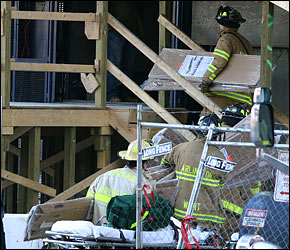
A concrete slab collapsed Dec. 8 on the 24th floor of a high-rise building under construction in the Rosslyn district of Arlington County, trapping three workers and injuring a dozen more.

Arlington County firefighters - along with fire crews from the Fort Myer military post, the City of Alexandria and Fairfax County - treated the casualties. A surgical team from George Washington University Hospital also responded. The size of the alarm assignment was the equivalent of a general alarm fire.

The incident - at 1901 North Lynn St. - recalled high-rise construction accidents at job sites in Crystal City in 1968 and Bailey's Crossroads in 1974.

Construction worker Oscar Moscoso, who was on the roof of the high-rise, told reporters that a scaffold failed - triggering the collapse of wet concrete at about 8:30 a.m. Workers - who had planned a "topping-out" party later in the day - used their hands and shovels to reach the injured before firefighters and paramedics arrived.

Arlington County Fire Captain Tom Polera said an approximately 60 x 30 foot area of the roof collapsed onto the 24th, or top floor, of the building about 2 1/2 hours after workers began pouring concrete, according to The Washington Post.

During the rescue, a firefighter suffered a back injury.

Battalion Chief Scott McKay - Battalion 112 - was the incident commander.

Units assigned to the alarm, according to ACFD3.COM:

Engines: 102, 103, 105, 106, 108, 110, 161, 202

Trucks: 104, 208

Rescues: 104, 109, 206

Medics: 101, 102, 104, 105, 106, 109, 110, 202, 205, 208, 401, 418

Also: Command Unit, Hazmat 101, TRT 110, Hazmat 202, Mass Casualty Unit, Battalion 111, 112, FM 114, EMS Chief, Services Chief.

The Falls Church volunteers sent their canteen unit, Canteen 106.

Friday, July 28, 2006

NO RESPECT - 1922


The following tale is based on a speech by former President Gerald Ford on being Vice President of the United States.

In 1922, a general alarm fire broke out in the ballroom atop the Willard Hotel in Washington, and firefighters evacuated guests - including then Vice President Calvin Coolidge.

As the time passed, Coolidge grew tired of waiting in the street and decided to return to his hotel room.


As he headed for the stairs, a fireman demanded identification.

"I am the Vice President," Coolidge said.

The fireman asked: "Vice President of what?"

"Vice President of the United States," Coolidge said.

"Then get back here," the fireman said. "I thought you were Vice President of the hotel."

Coolidge, of course, went on the become president of the United States, earning a little more respect. 

Thursday, July 27, 2006

FIRE AND FLOOD - 2006


Falls Church warehouse fire
(Photo courtesy of http://www.acfd3.com/)

The Arlington County Fire Department contended with fire and flood in late June and early July 2006.

Firefighters employed master streams to extinguish a three-alarm warehouse fire in the 2000-block of North Westmoreland Street - just across from Station No. 6 in Falls Church - on July 15.

``Engine 106 arrived to find heavy fire blowing out of the Adam and Baker sides of a vacant one-story 75' X 150' former moving and storage warehouse,'' according to Capt. Randy Higgins on acfd3.com. ``The second and third alarms were quickly sounded bringing virtually the entire on duty crews from Arlington and over 11 units from Fairfax County.''

Just over a week earlier, on June 30, firefighters tackled a two-alarm fire in a high-rise at 4250 North Fairfax Drive in Ballston - an alarm that initially came in as a medical emergency.

Instead of a patient, a building engineer greeted Engine 102 and Medic 102 and ``advised them of sparks coming from an electric panel in the main electric vault on the P-1 level,'' according to Higgins. ``Engine 102 called for the box to be filled ... and then proceeded to the fire control room where multiple devices on multiple floors were lighting up the panel! ''

Office workers on the 13th floor reported water pouring from the ceiling, and firefighters sent to the floor above - No. 14 - discovered heavy smoke and fire, which was promptly entinguished, according to Higgins.

Firefighters also answered hundreds of calls during the worst rain in more than 100 years of record keeping in late June.

The Arlington County Emergency Communications Center dispatched more than 580 service calls to police and fire units between 9 p.m. on June 25 and and 11 a.m. the next day, according to the county government web site.

Career and volunteer firefighters activated additional units to respond to all the alarms.

Tuesday, June 06, 2006

APPARATUS GALLERY

Foam 161 - Pentagon Heliport & Fort Myer

Foam 326 - Reagan National Airport

"Christine" - Old Reserve Truck

No. 3's "wagon" in Rosslyn

Old Wagon 9 and other apparatus

Old Truck 3

Old Falls Church firehouse

Light Unit & Utility 73 - Iwo Jima Memorial (1990)

Truck 106 on the job

Rescue Engine 324 - Reagan National Airport

Engine 3 - Cherrydale firehouse

Engine 3 refurbished as foam wagon

Quints 104 & 109

Old Engine 61 - U.S. Army Fort Myer

Wednesday, May 31, 2006

MEDSTAR DOWN


A Medstar helicopter that serves Arlington County and the rest of the metropolitan area crashed May 30, 2006, as it approached the Washington Hospital Center in the District of Columbia.

The medevac patient - already in grave condition - died hours later in surgery. The crash injured Medstar's three crew members.

According to The Washington Post, the Eurocopter - on a flight from Greater Southeast Community Hospital - plummeted onto a golf course on the grounds of the Armed Forces Retirement Home on North Capitol Street, Northwest, at about 5 p.m.

The pilot had transmitted a distress call.

"I could see [the helicopter] laboring," witness Jay Speights, who was getting out of his car at the golf course parking lot, told the Post.

According to a 2005 report on the Washington Hospital Center's web site, the helicopter service - which is operated by the hospital center - carried more than 36,000 patients ``with a perfect safety record since its inception in 1983.''

The Medstar service evacuated casualties from the Pentagon on Sept. 11, 2001.

The fleet consists of three EC-135 choppers, which have a cruising speed of 150 mph and a range of approximately 250 miles, according to the Medstar Transport web site. The standard flight crew consists of a pilot, critical care nurse and a critical care paramedic.

Tuesday, May 30, 2006

2-ALARM CHURCH FIRE


By Captain Charles A. Gibbs

Arlington County Fire Department

On 24 May 2006, at 1058 hours Box 4603 was struck for a structure fire at 103 West Columbia Street, Columbia Baptist Church (Falls Church). This church is a large complex consisting of several different interconnected buildings fronting on four streets. The church houses and hosts quite a few ministries including 250 pre-school children. The fire was in a storage area above the pulpit area of the main sanctuary.

EMS 112 arrived on the scene within three minutes reporting smoke showing from the eves on the W. Jefferson Street side. He designated this side Adam and established command. He quickly called for a second alarm. Engine 106 arrived and stretched a handline to the second floor through a doorway on the Baker side, quadrant Adam. Truck 106 took a position on side David. They positioned the aerial to the roof and raised numerous ground ladders on side David and Baker. The crew proceeded inside to assist Engine 106. Engine 102 reversed laid a supply line for Engine 106 and the crew advanced the backup line from Engine 106 to the second floor.

Engine 418 (Fairfax County) established a secondary water supply in the parking lot across the street from the church. The crew proceeded to the second floor. Rescue 418 proceeded to the second floor to assist with extinguishment and checking extension. Engine 103 established the RIT side Adam at Engine 106. They surveyed all sides checking ground ladder placement.

Battalion Fire Chief 112, Blankenship, established the command post at the buggy across the street from side Adam. Truck 104 positioned on Side Charlie, raised the aerial to the roof and assisted with ventilation. BFC 111 was designated the interior division. Medic 102 established an aid station on the Adam side and later established the rehab division. Units on the interior had no difficulty locating and extinguishing the fire. The fire was knocked down in ten minutes and completely out in twenty minutes. There was no extension above the fire room.

The second alarm units were ordered to report to command on arrival. Engine and Truck 410 relieved Engine 106, Engine 102 and Truck 106 on the second floor. I do not know the other companies assignments.

The fire was in an area above the pulpit in a 15’ X 15’ concrete room. It was used for storage. The all concrete construction held the heat for quite awhile but it did not present any problems. The location of the fire room allowed for fairly quick smoke removal from the fire area but unfortunately it dissipated into the sanctuary.

As is found in a lot of churches the sanctuary was approximately 50’ high and proved challenging for smoke removal. Smoke removal was accomplished by strategically placing several positive pressure fans. There was some minor smoke travel in other areas of the church that mostly dissipated on its own. Fairly late in the operation a crew from 418 went to the roof to check for extension.

All building occupants including the 250 children self evacuated and were accounted for very early on in the incident. It must be stated that for the teachers to control and account for 250 children is a testament to their responsibilities. They maintained control of the children without incident.